SKU: 60926145359
succulents stapelia

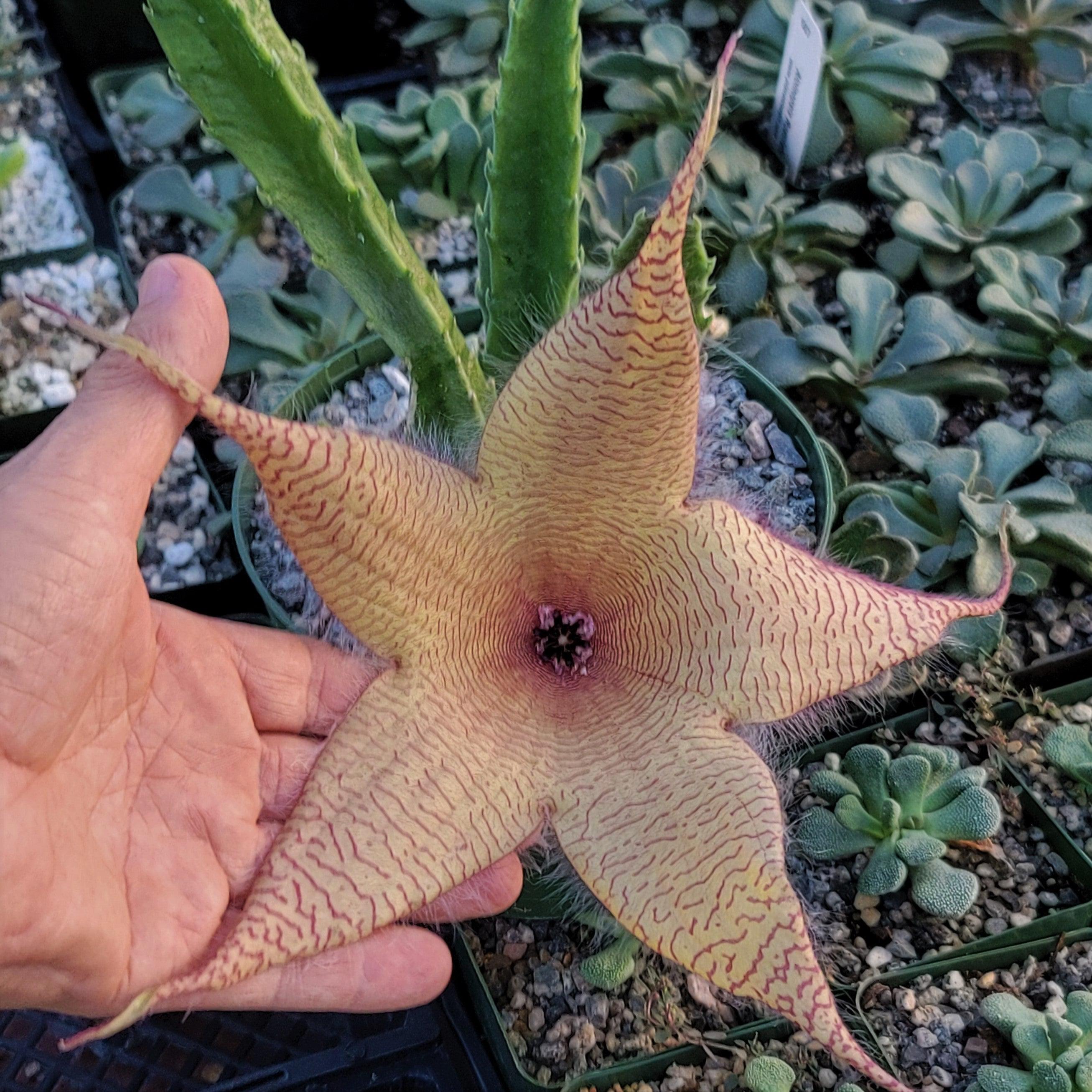
succulents stapelia Carrion Plant 'Stapelia gigantea' 4" Pot

Sale price$26.95 Regular price$29.94
Save 10%

Pay in installments of $7.49 with ShopPay, AfterPay and Klarna

Shipping Estimate
USA
  • USA
  • CAN

Ships within 48 hours · Estimated delivery Jul 21 - Jul 26

Promo Codes Available:

For Your Every Summer RSVP, with Code: SUMMER15

Description

succulents stapelia Carrion Plant 'Stapelia gigantea' 4" PotThe Carrion plant, known as Stapelia gigantea, is known for having the largest flowers of almost any succulent in the world. Native to South Africa, the Stapelia gigantea has several other common names, such as carrion flowers, starfish plant, starfish flower, toad plant, and zulu giant plant. The term "carrion" is used to describe the unpleasant, foul odor associated with decaying flesh. This Stapelia gigantea gets its common name because its flowers

The Carrion plant, known as Stapelia gigantea, is known for having the largest flowers of almost any succulent in the world. Native to South Africa, the Stapelia gigantea has several other common names, such as carrion flowers, starfish plant, starfish flower, toad plant, and zulu giant plant.

The term "carrion" is used to describe the unpleasant, foul odor associated with decaying flesh. This Stapelia gigantea gets its common name because its flowers emit a strong, unpleasant, carrion-like smell, which resembles rotting meat. The odor is what attracts flies and other pollinators in their natural habitat.

Stapelia gigantea is a spineless stem succulent that resembles a cactus; it can grow up to 2 feet tall and may form big clumps when growing up to 3 feet wide. These thick, fleshy stems are ribbed and have a green coloration, with some variations in shades. 

The Carrion has Huge Flowers 


The flowers of the Stapelia gigantea are large, about 15 inches, and star-shaped; they bloom during the fall.

They have pale yellow to reddish brown hues adorned with intricate patterns and markings. The petals are thick and fleshy, and they curve backward, giving the flowers a star-like appearance.

The carrion flowers smell like rotten flesh; although this sounds disgusting, it helps attract flies and other pollinators to the Stapelia gigantea.

Interestingly, it also looks like drying flesh peeling from the bone, and also fringes of soft white hairs on the corolla segments superficially resembling a layer of mold growing on rotting matter.  

The cluster of flowers arises near the base of a branch; on this carrion plant, the inflorescence had two buds with scale-like leaves at the base of the petioles.

Despite their unusual smell, the flowers of the Stapelia gigantea can be quite beautiful and captivating. They are a testament to the diversity and uniqueness of nature. If you ever come across these flowers, be sure to take a moment to appreciate their intricate beauty, even if the smell might not be to everyone's liking! 

When and How to Water Your Carrion Plant 

The Carrion Plant is a highly drought-tolerant succulent, meaning it can store water in its thick stems and survive long dry spells. Overwatering is one of the most common mistakes with this plant, so it’s important to mimic its natural dry habitat by keeping watering minimal. The carrion plant prefers watering once every 2-3 weeks in the growing season, and once in 4-6 weeks during the dormant season.

In spring and fall, during the growing season, the carrion flower plant prefers watering once every 2–3 weeks is sufficient, but frequency should be adjusted depending on your conditions, such as temperature, humidity, and soil drainage. Using the soak and dry method, water thoroughly until excess drains out of the pot, then wait until the soil has completely dried before watering again. 

In winter, during the dormant season, the Carrion plant slows down its growth to watering once every 4–6 weeks, or even less, is usually enough. During this period, allow the soil to stay dry for extended periods, watering only when the stems show signs of dehydration, like slight wrinkling. Providing too much water in dormancy can lead to root rot, so it’s best to keep it on the drier side.

Light Requirements - Where to Place Your Carrion Plant

When growing your Stapelia gigantea indoors, it thrives in bright, indirect light for 4-6 hours a day. Avoid placing it in direct sunlight, as the intense rays can scorch the leaves and cause damage to the carrion plant. If you notice that the stems are stretching or leaning toward the light source, it's a sign that it needs more light. In that case, you can consider supplementing with artificial grow lights to provide the necessary brightness. 

When growing outdoors, it works best in full sun to partial shade. It can tolerate some direct sunlight, especially during the morning or late afternoon, but it's best to avoid the scorching midday sun. A location with dappled sunlight or a spot under a tree that provides filtered light can be ideal for the carrion plant. Just make sure it still gets enough brightness to thrive. 

Remember, finding the right balance of light is crucial for the health of the Stapelia gigantea. Too much direct sunlight can cause sunburn and damage the plant, while insufficient light can lead to weak growth and poor blooming.

Optimal Soil & Fertilizer Needs

The Carrion plant prefers a well-draining soil mix and should be fertilized once a year in spring. You can create a suitable blend by combining equal parts of potting soil, perlite, and coarse sand. Instead, make or buy a well-draining potting mix, or ideally, use our specialized succulent potting mix, opens in a new tab: Soil cactus mix blend 1 gal 4 qt cacti succulent dirt compost growing media that contains 5 natural substrates and mycorrhizae to promote the development of a strong root system that helps your succulent to thrive. 

The Stapelia gigantea carrion plant doesn't require frequent fertilization, but it can benefit from light feeding during the growing season. Fertilize once a year during the growing season in the spring with a balanced NPK fertilizer of about 5-10-5. Be cautious not to over-fertilize, as this can result in excessive growth with fewer blooms.This provides a slow-release source of nutrients and helps improve the overall soil structure. 

Hardiness Zone & More 

In the United States, this is mostly an indoor plant, but if you live in southern Florida or Hawaii, then you can cultivate it outdoors in USDA zones 10-12.

It can tolerate higher temperatures, but it's essential to provide some protection from the intense midday sun, especially in hotter climates.

In terms of humidity, the Stapelia gigantea can handle a range of humidity levels, but it appreciates moderate to high humidity. 

Remember to acclimate your Stapelia gigantea gradually when transitioning it from indoor to outdoor or vice versa. Sudden changes in temperature or light can stress your carrion plant. Take care to protect the plant from extreme weather conditions like frost or excessive heat. 

How to Grow the Best Carrion Plant Indoors

The Stapelia gigantea is native to warm, tropical regions, so it thrives in indoor environments where temperatures are consistently between 60°F and 80°F. It prefers bright, indirect light, so placing it near a window with filtered sunlight works well. In terms of humidity, this plant can tolerate average indoor humidity levels, but it appreciates a slightly higher humidity level. You can increase humidity by placing a tray of water near the plant or by using a humidifier. 

Wildlife - Carrion Flowers Attracts the Following Friendly Pollinators

Carrion flowers attract flies, such as blow flies, flesh flies, and house flies, along with some beetles and even mosquitoes. These pollinators are drawn to the flowers' foul smell, mimicking the scent of decaying flesh.

According to the ASPCA, the Carrion Plant (Stapelia gigantea) is mildly toxic to humans and animals if ingested, and its sap can cause skin irritation, so it should be handled with care and kept out of reach of children and pets. 

How to Propagate Your Stapelia gigantea

To propagate your Stapelia gigantea, you can easily do so by taking stem cuttings from a healthy plant. Make sure the cutting has calloused over before planting it in well-draining soil, and keep it in a warm, bright location to encourage root growth. Water sparingly until roots have established, and soon you will have a new plant ready to thrive in your collection. 

Key Takeaways

  1. The Carrion Plant produces some of the largest flowers in the succulent world, often reaching up to 12 inches across.
  2. Its blooms release a distinct carrion-like odor, which attracts flies for pollination—an unusual but fascinating survival strategy.
  3. The flowers are hairy, star-shaped, and leathery, making them look almost unreal, like something from another world.
  4. As a drought-tolerant succulent, it thrives on neglect and prefers the “soak and dry” method of watering.
  5. Instead of bees or butterflies, this Carrion plant relies mostly on flies and beetles to pollinate its massive blooms.

The Bottom Line 

Overall, the Stapelia gigantea (Carrion plant) is unique and captivating, with its large, star-shaped flowers that have a distinctive carrion-like scent, hence known as carrion flowers. It is a low-maintenance succulent plant that thrives in bright, indirect light and well-draining soil. The Stapelia gigantea is also known for its ability to attract pollinators like flies, making it a great addition to any garden or indoor collection.

So, if you're looking for a striking and low-maintenance succulent for your rock gardens, the Carrion Plant Stapelia gigantea is definitely worth considering! 

Shipping Notes
  • Free Standard Shipping on $100+ Orders to the USA.
  • Except Preorder products are shipped in 48 hours.
  • Delivery to the USA:
  1. Standard Shipping : 3-10 business days
  • If time is of the essence, please consider selecting expedited delivery for faster service.
Exchange/Return Notes
  • We offer a 30-day return/exchange service after receiving.
  • Final sale items are not eligible for returns or exchanges.
  • To process your return/exchange, please contact us at [email protected]
  • Please click here for more details>>> Return & Exchange Policy
SKU: 60926145359

Discover Niche Categories That Outsell succulents stapelia

Top-Converting Item to Boost Your Average Order

4.2 ★★★★★
Based on 9 reviews
Sort
Highest Rating
Newest First
Oldest First
Product Reviews
D
Verified Purchase
DavidAyers
Lake Worth, US
★★★★★ 5
Timely and Highly Important Must-Read Book
Format: Hardcover
I had the wonderful opportunity of reading an advanced copy of this book over the past month, and of course also pre-ordered it here on Amazon. I read this book thinking it would be an analysis of the modern attack on masculinity and its impact on men and boys. As a Sociology professor of over 35 years who writes and teaches extensively on marriage and family issues, of course I also (a) try to keep up on new material relevant to my studies, and (b) am in a pretty good position to evaluate the author's handling of the research. This is so much more than I thought it would be. I never fully appreciated the long-term history and roots of the attack on masculinity until I read this. Pearcy's handing of diverse historical sources from across the ideological spectrum is masterful. I learned new things, and also perhaps even more loved her application of things I already knew to understanding the contemporary dilemma. She also uses incredible analogies. I especially liked comparing what masculinity was created to be and naturally is, versus what it has often been twisted into, to perfectly good software that has been attacked by a virus. We mistake the virus for the software. I also enjoyed the way she wove her own biography into the beginning and end of the book judiciously. Her analysis of the contemporary issues in the church, particularly the mishandling of Scripture and of abuse cases by pastors and elders, is valuable. I am very familiar with a church that went through a split over precisely this kind of thing -- elders protecting an elder who had been abusing his wife for years while gaslighting the wife and even family members who affirmed this woman's complaints, treating a problem with the elder as if it was a marital issue with "two sides," and so on. This is a too-familiar story. I recommend this book without hesitation. I am already personally recommending it to others to buy and read. I will consider making this required reading in my next Family class. And this would be a fantastic choice of a book to do a Sunday School class or church bible study around. The length makes it perfect for a semester of reading, and Pearcy writes incredibly well, free of jargon, beautiful flow.
WAS THIS REVIEW HELPFUL?YesReportShare
Reviewed in the United States on June 28, 2023
J
Verified Purchase
Jen
Lexington, US
★★★★★ 5
Fascinating and important history of masculinity in Americz
Format: Hardcover
Our boys are not ok. Our families are not ok. “Despite the growing evidence that boys are falling behind, many people resist proposals to help young males. After all, they say, men still end up in most positions of power. And it’s true that men are more likely than women to be presidents, CEO’s, film directors, Fortune 500 board members, and Silicon Valley entrepreneurs. But while we focus on the maybe 10 percent of powerful, successful alpha males, we have been blinded to the fact that on average men are doing worse than in the past. Men are more likely than women to be homeless, to suffer mental illness, to wind up in prison, to commit suicide, to be murdered, to be addicted to drugs or alcohol…in recent years, men’s life expectancy has even gone down, while women’s has remained the same” (page 25) Nancy Pearcey uses decades of social science data and historical research to demonstrate how and when the cultural script for masculinity turned toxic - from one that reflected the biblical definition of manhood (provide, protect, and serve wife, family, and community as Christ served his church) to one that has become nearly the exact opposite- and how it has fueled the ever widening rift between the sexes. Spoiler alert: the Industrial Revolution, Post-modernism, and Darwinism played major roles in turning the script for masculinity toxic. This book has the most concise and beautiful explanations of biblical manhood, womanhood, and marriage - including defining headship and submission- that I have read. Pearcey shows through hard data how communities have flourished under God’s plan for marriage and how society denigrates the further it strays from that plan. Men and women were made to be “co-heirs in the kingdom of God” (Peter 1:3) not fighting a battle of the sexes. While the problem has been a drastic move from the biblical definition of manhood, the author chronicles how the church in many cases has been implicit in allowing this toxic and unbiblical version of manhood. Interestingly, Pearcey herself grew up in a Christian home with an abusive father, causing her to become agnostic (and feminist) until later in her life when she found Christ. A large part of the book addresses domestic abuse and how many churches have empowered entirely unbiblical male dominance. She also sets forth practical solutions for both families and churches on how to reclaim the script of masculinity that lifts up and empowers not just men but also women and communities. One way is to make the career more flexible to allow men to take more active roles in the family. This is a really important book for a time when “children with absent fathers account for 63 percent of youth suicides, 90 percent of homeless and runaway children, 85 percent of children who exhibit behavioral disorders, 71 percent of high school dropouts, and 85 percent of youths sitting in prisons.” P.193
WAS THIS REVIEW HELPFUL?YesReportShare
Reviewed in the United States on July 7, 2023
M
Verified Purchase
Mike M.
New York, US
★★★★★ 5
Very relevant
Format: Hardcover
Good research on the subject
WAS THIS REVIEW HELPFUL?YesReportShare
Reviewed in the United States on March 8, 2026
J
John Divito
Belleville, US
★★★★★ 4
Helpful Insights about Modern Masculinity and the Social Goodness of Biblical Masculinity
Format: Hardcover
In the midst of contemporary debates about masculinity and femininity in America and the West, Nancy R. Pearcey seeks to bring clarity through tracing the historical development of modern masculinity and explaining the social goodness of biblical masculinity in her book The Toxic War on Masculinity: How Christianity Reconciles the Sexes. Throughout this work, she contrasts the difference between the Good Man versus the "Real" Man, and urges us to embrace the true masculinity of the Good Man instead of the toxic masculinity of the "Real" Man. Pearcey establishes her argument through the lenses of a biblical worldview of Creation, Fall, and Redemption, which was practiced by Protestants since the Reformation in their relationship between men and women. But the Industrial Revolution removed men from the home and away from their families, and this shift led to a change in the conception of masculinity (and femininity). As she summarizes: "The Industrial Revolution became a watershed in the social definition of masculinity. By taking husbands and fathers out of the home, industrialization created the material conditions that made it more difficult to fulfill a biblical ideal of manhood. Men were no longer physically present enough to be fully engaged husbands and fathers. They spent most of their time in the public realm, which was growing increasingly secular. The Industrial Revolution thus became a catalyst for the acceptance of secular views of masculinity" (101). Therefore, a transition took place from communal manhood to personal, self-interested manhood. As a result, the values and lifestyles of men changed into what is now recognized as toxic masculinity. So the problem we face today is not the result of Christianity and its teaching of biblical manhood, but the perversion of true masculinity through modern secularized individualism and the abusive twisting of male headship and female submission among largely nominal Christians. This means that our solution is returning to God's revealed ideal for the sexes in Scripture, which is how God intended for his image-bearers to relate to each other. I appreciated Pearcey's historical overview of how masculinity developed from Puritanism to today. It was both informative and challenging, causing me to consider how much my own understanding of masculinity has been influenced by my culture rather than by God's Word. As a self-confessed devotee of Francis Schaeffer, I can see how much of an impact he has had in her thinking and writing. And like Shaeffer, Pearcey may be criticized for an overly simplistic tracing of ideas through history. But the general contours of her survey seem accurate enough, and help us to identify what has led to contemporary troubles with masculinity. At the same time, I would have appreciated more emphasis on biblical exposition when explaining the Christian worldview as it applies to men and women. While I recognize that she was not intending a Bible study, she often quotes Scripture and draws conclusions which at times I found questionable or could have been clarified by a more thorough treatment of the text. Other relevant passages from God's Word on the relationship between men and women were also left unaddressed. The result is that I have reservations and disagreements with some of Pearcey's conclusions. Furthermore, I sensed a strong influence of Neocalvinist transformationalism, especially as it related to the cultural mandate. Thus, I would find myself differing from the author in some of her assessment and application. Nevertheless, I wouldn't want these cautions to keep anyone from reading her book. She clearly wants us to engage her arguments, and she provides and important voice in today's debates surrounding masculinity. So I will be encouraging anyone thinking through what it means to be masculine or how to raise boys in today's world to read Pearcey's timely book. Read it carefully and with discernment. I hope that the Lord uses it to help us reconcile the sexes through Christ.
WAS THIS REVIEW HELPFUL?YesReportShare
Reviewed in the United States on November 29, 2023
R
Verified Purchase
rodboomboom
Lowell, US
★★★★★ 5
Another Pearcey Vital and Engaging Book The World Needs Now
Format: Hardcover
I must disclose from the outset that this reviewer is a real Pearcey fan! Not only have I read most all of her books, but in addition I had the pleasure years ago of interviewing her several times on Worldwide KFUO radio BookTalk and Cross Defense programs. She is an outstanding Christian thinker and writer and this new volume is the latest evidence of her God-given talents. What in my mind sets this book apart from her previous ones is this quote from the book: "When I began to write this book, I did not anticipate that it would become the most controversial book I have ever written. The term masculinity has become a trigger word." That is because it hits very sensitive spots in our culture which need Christ's healing touch of the Gospel. Pearcey achieves this necessary cultural corrective not only in the public square but in the Christian church as well. And she does so by a very effective and somewhat unique style of asking pertinent questions and then answers them by her very thorough and probing research skills. What opened this reviewer eyes was the enormous amount of historical and sociological studies which back her premise that The Good Man of previous times has been displaced by the Real Man script that is so pervasive in America now. She does not leave this problem's disclosure just for the reading, but provides the church definitive corrective suggestions which are biblically based. Cannot recommend this enough for your purchase. Devour it as I did. You'll be blessed! Gift it, share it, talk about it at your church, within your family, with your circle of contacts.
WAS THIS REVIEW HELPFUL?YesReportShare
Reviewed in the United States on July 11, 2023

recommand products